
Criminal Cases in the Wright County Courts
Wright County government places the local court counter in Clarion, and Wright County belongs to Iowa Judicial District 2A. The Iowa District Court for Wright County is part of one unified state trial-court system. District judges hear felonies and major matters. Associate district judges have authority over indictable misdemeanors and assigned felony proceedings. Magistrates handle simple misdemeanors, initial appearances, and other limited work. These are divisions of the Iowa court system, not separate county record stores.
Eagle Grove, Clarion, and Belmond do not run stand-alone municipal criminal courts of the type found in some states. City citations and state offenses are filed in Iowa District Court. The Wright County clerk is the custodian of those case files. A filed case may include several counts, and each count can have its own result. Searchers should match the county, Case ID, party name, and charge rather than treating a single name hit as a final answer.
One Wright County Criminal Docket
The unified structure prevents a common search error. A simple misdemeanor may be handled by a magistrate and a felony by a district judge, yet both appear through the same statewide case system and local clerk. There is no need to hunt for a city criminal-court portal. The useful distinction is the level of judicial work, not a different database.
Case labels also matter. An indictable misdemeanor is more serious than a simple misdemeanor and falls within associate district jurisdiction. A felony carries a class label from A through D. The docket ties each filed charge to its statute and class, so it is safer than guessing from the plain-language offense name. A court event marked “disposed” means the court has finished the matter or count; it does not always mean a conviction.
- Case ID
- The court-assigned identifier used to open the correct Wright County case.
- Docket
- The date-ordered list of filings, hearings, rulings, and other case events.
- Disposition
- The result of a charge, such as dismissal, conviction, acquittal, or deferred judgment.
- Deferred judgment
- An Iowa outcome that delays judgment while conditions are completed; successful discharge is not a conviction.
How to Search Case Records
Iowa Courts Online Search is the first access channel for Wright County criminal cases. Its basic Trial Court Case Search is public. Name searches need at least two letters in the Last/Firm Name box. The percent sign works as a wildcard. Spell the indexed name carefully, and omit the period after a first initial. Advanced Case Search and Schedule Search may require a paid subscription or a courthouse public terminal.
- Open Trial Court Case Search and choose the name route or the Case ID route.
- Enter at least two last-name letters, then add first or middle name when it will reduce false matches.
- Select Wright County when county narrowing is available. Use AND or OR carefully when two names are entered.
- Open the Case ID, confirm the county and case type, and read every charge, event, and disposition.
- Ask the Wright County clerk for an older, certified, non-imaged, or security-controlled public document that is not available online.
The current official help describes these fields and controls. A blank or unavailable document link does not prove that the filing is absent. It may be limited to a subscriber, a clerk terminal, or a copy request.
| Field Label | Type | Required | Notes |
|---|---|---|---|
| Last/Firm Name | Text | Yes for name search | At least two letters; percent sign wildcard supported. |
| First and Middle Name | Text | No | Use an initial without a period; helps narrow common names. |
| County | Dropdown | No | Select Wright for local results. |
| Case ID | Text | Yes for ID search | Enter the court identifier exactly. |
| Case Type and Date Range | Filters | No | Advanced and schedule tools may require a subscription or terminal. |
Note: Use the clerk counter when the free result identifies a case but does not expose the document needed to understand it.
Wright County Criminal Clerk Counter
The Wright County clerk works on the courthouse second floor at 115 North Main Street, Clarion, Iowa 50525. The phone is 515-532-3113. Posted hours are Monday through Friday, 8:00 a.m. to noon and 1:00 to 4:30 p.m. The noon closure is easy to miss because the wider county building posts a different daily schedule.
The counter adds three forms of access that the anonymous web view cannot always supply: a public-access terminal, help locating older or non-imaged material, and plain or certified copies of public documents. Bring the Case ID and the exact document name when possible. Ask the clerk to confirm current copy prices because the reviewed official sources did not publish a dependable local fee. The clerk is a Judicial Branch office even though it sits in the county courthouse.
The official clerk page shows the local access point.
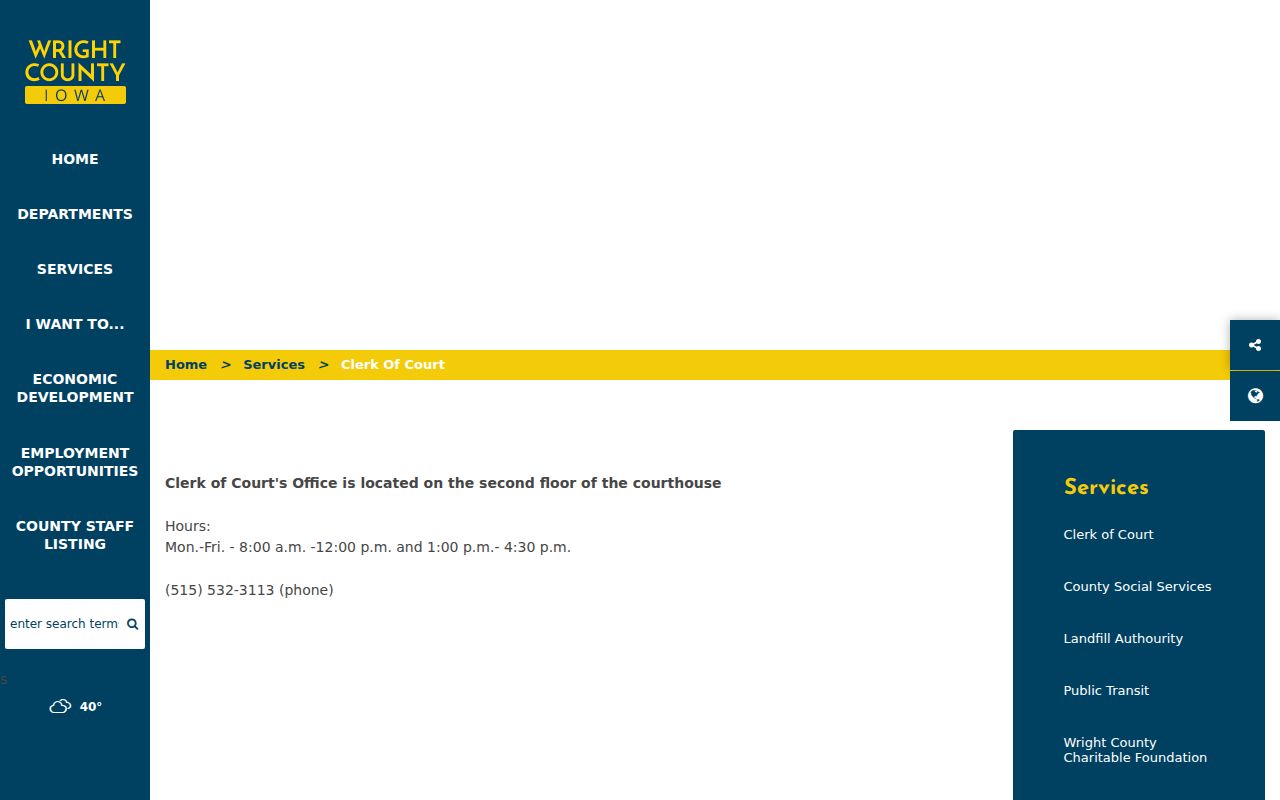
That local page confirms where a search moves when the statewide docket view is not enough.
What the Case File Shows
A Wright County criminal court file records the prosecution after filing. The initial complaint or trial information states what the State alleges. Docket entries mark later filings and hearings. Orders show what the judge decided along the way. The judgment and sentence show the legal result. Financial fields may list assessed costs, fines, payments, and balances when public. Each source answers a narrower question than the broad phrase “criminal record.”
| Case Number & Court | Identifies the Wright County file, court, type, filing date, and status. |
|---|---|
| Charging Document | Lists the formal counts, alleged facts, statutes, and offense classes filed with the court. |
| Docket Entries | Chronological events such as filings, orders, plea activity, and judgments. |
| Hearing Dates | Public hearing type, date, time, place, and judicial officer when shown. |
| Disposition & Judgment | Shows the outcome of each count, which can differ within one case. |
| Sentence & Conditions | Records confinement, probation, restitution, costs, and other terms imposed. |
A party listing or case status alone is not the outcome. Open the charge section and read each disposition. If the result matters, obtain the filed judgment or order from the clerk. The broader path from arrest through charge and custody is covered in the Wright County arrest history, but the court file controls the filed charge and final court result.
Missing Wright County Court Filings
Iowa's Electronic Document Management System assigns security levels to cases and documents. Anonymous users generally see the public slice, but not every document link is open at that level. Some links become available through a courthouse terminal or subscriber account. Others remain restricted because the case, document, or data is confidential. Open search-warrant material, juvenile cases, protected identifiers, and expunged or sealed records do not display like an ordinary public case.
When a known Wright County Case ID opens without the filing you need, first confirm the event appears on the docket. Then note its date and title. Call or visit the clerk and request that specific item. An older file may not be imaged. A public filing may also need redaction before release. If the clerk says a security rule blocks access, a paid search subscription will not override that rule.
Iowa Courts Online shows the public search entry used for Wright County cases.
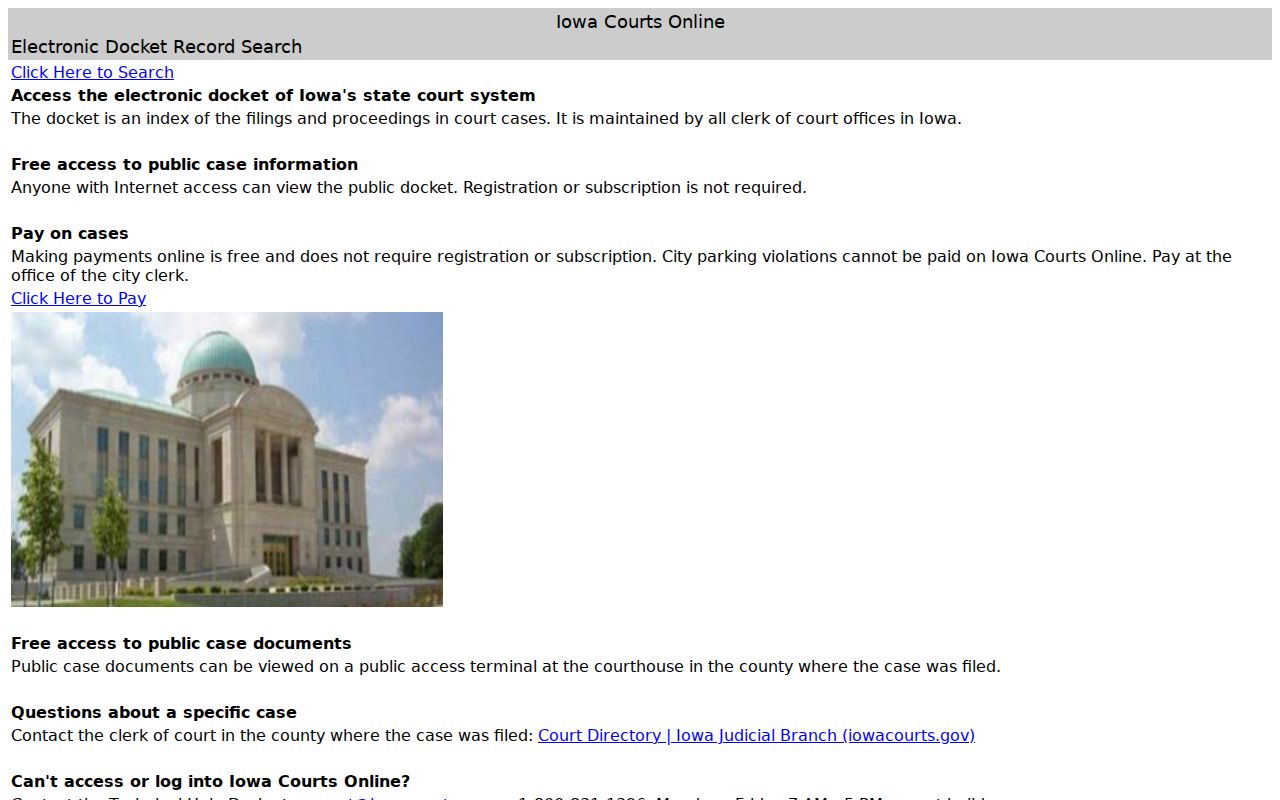
The statewide form is the start of a case search, while the clerk remains the source for public documents beyond the remote view.
Stages of a Criminal Case
A Wright County case can start with an arrest or a summons. A jailed person receives a prompt initial appearance. A complaint and probable-cause review come next, followed where applicable by a preliminary hearing or waiver. The prosecutor then files a trial information, or a grand jury returns an indictment. At arraignment, the charge is stated and a plea is entered. Discovery and motions shape what follows.
Case flow: Charges Filed › Arraignment › Pretrial › Plea or Trial › Disposition › Sentencing
Many cases resolve by negotiated plea, while others proceed to trial. Judgment and sentence follow a guilty plea or verdict. Appeals or postconviction proceedings can add later docket entries. No fixed local time applies to every step. The key is to read dates and events in order, then use the final disposition rather than the booking description.
Reading Wright County Case Outcomes
One Wright County criminal case can end with mixed results. A count may be dismissed while another ends in conviction. A charge may be amended to a different statute or class. The overall case status can say “disposed” even when the dispositions vary. Read across each charge row and match the description, statute, date, and outcome before drawing a conclusion.
A deferred judgment needs special care. Iowa delays judgment while the person completes court terms. A successful discharge is not a conviction, yet access can differ across the court and DCI systems. An acquittal is a not-guilty result after trial. A dismissal ends a count without a conviction on that count. Neither word should be replaced with a vague claim that the case simply vanished.
For a Wright County record that seems wrong, save the Case ID and identify the exact entry. Ask the clerk about the filed order or judgment. A DCI rap sheet is a separate fingerprint-backed repository record, so a correction to that history follows DCI's process after the court result is confirmed.
Access & Restrictions
Iowa's public-access framework begins with the Iowa Open Records Law, while Iowa Court Rule chapter 16 governs electronic court security and access. Public dockets can still omit protected personal data and restricted documents. Most juvenile information, expunged files, protected victim or minor information, Social Security numbers, financial-account data, and open warrant material may be confidential or security controlled.
The online view is not always the full public file. A clerk terminal can expose functions unavailable to an anonymous user, but it does not open legally confidential material. For an absent Wright County case, check name spelling, use the wildcard with care, try the Case ID route, and call the clerk. A missing search result is not proof that no record exists. It may reflect an index mismatch, delay, expungement, confidentiality, or a case outside Iowa's state courts.
Federal prosecutions from Wright County are different. They belong in the U.S. District Court for the Northern District of Iowa and are searched through PACER, not Iowa Courts Online. The local clerk handles state District Court case files only.
Certified Wright County Court Records
A screen result may be enough to locate a case, but it is not a certified court record. Ask the Wright County clerk for the exact complaint, order, judgment, or sentence when a formal copy is needed. State the Case ID and filing date. The clerk can also explain whether the item is public, needs redaction, exists only in an older file, or can be certified.
Do not assume an arrest report, DCI history, and court judgment are interchangeable. The arresting agency holds its report. DCI maintains the fingerprint-backed statewide history. The clerk holds the filed prosecution. Compare them by identifiers and dates when reconstructing what happened. If the booking charge changed before filing, the Wright County judgment and charge disposition show the court outcome.