
How to Check Criminal History in Eagle Grove
Begin with the office that made the record. An Eagle Grove police report is not the same product as a jail booking, court docket, or DCI history. The city has no all-in-one criminal database, and the police department does not post a searchable blotter. That split makes a deliberate search faster than sending the same broad request to each office.
- Call Eagle Grove Police for an incident or arrest report and confirm what details staff need.
- Ask for the report at the police department during its listed weekday office hours.
- Call Wright County Jail when the main question is very recent custody or booking status.
- Search Iowa Courts Online with Wright County selected for charges filed in District Court.
- Use Iowa DCI for a statewide, fingerprint-backed history rather than a single Eagle Grove event.
A person checking their own record should compare names, dates, charges, and outcomes across the sources. If an arrest is absent from the court search, it may be too new, uncharged, indexed under a different spelling, or outside the public view.
Eagle Grove Criminal Record Starting Points
The official Eagle Grove city site is the first source for current city contacts and office information. The captured city page below shows the municipal route a local requester can use before moving to county or state systems.
That municipal starting point matters because Eagle Grove Police creates city reports. Wright County does not keep every police narrative in one pooled city-and-county file.
| Need | Official Eagle Grove route | What it can answer |
|---|---|---|
| Officer report | Eagle Grove Police | Reported event, officer action, and releasable incident facts |
| Current custody | Wright County Jail phone | Whether a person is held and releasable booking facts |
| Filed charge | Iowa Courts Online or clerk | Case events, charge disposition, and judgment |
| State history | Iowa DCI | Fingerprint-backed Iowa arrest cycles and reported outcomes |
The Eagle Grove Police Department
Eagle Grove Police and city offices use 121 North Commercial Avenue, Eagle Grove, IA 50533. City Hall is reached at 515-448-4343, and nonemergency dispatch is available around the clock at 515-448-4793. The public listing gives weekday hours of 7:30 a.m. to 4:30 p.m. Police reports are available at the department during those hours, but calling ahead helps confirm availability and any review needed before release.
The department posts no web report form, public arrest portal, fee table, or searchable daily blotter. A focused request should give the incident date, place, names if known, and desired format. Investigative details may be withheld, while basic incident facts may still be public under Iowa law.
The official Eagle Grove Police page provides the source for the department contact image below.
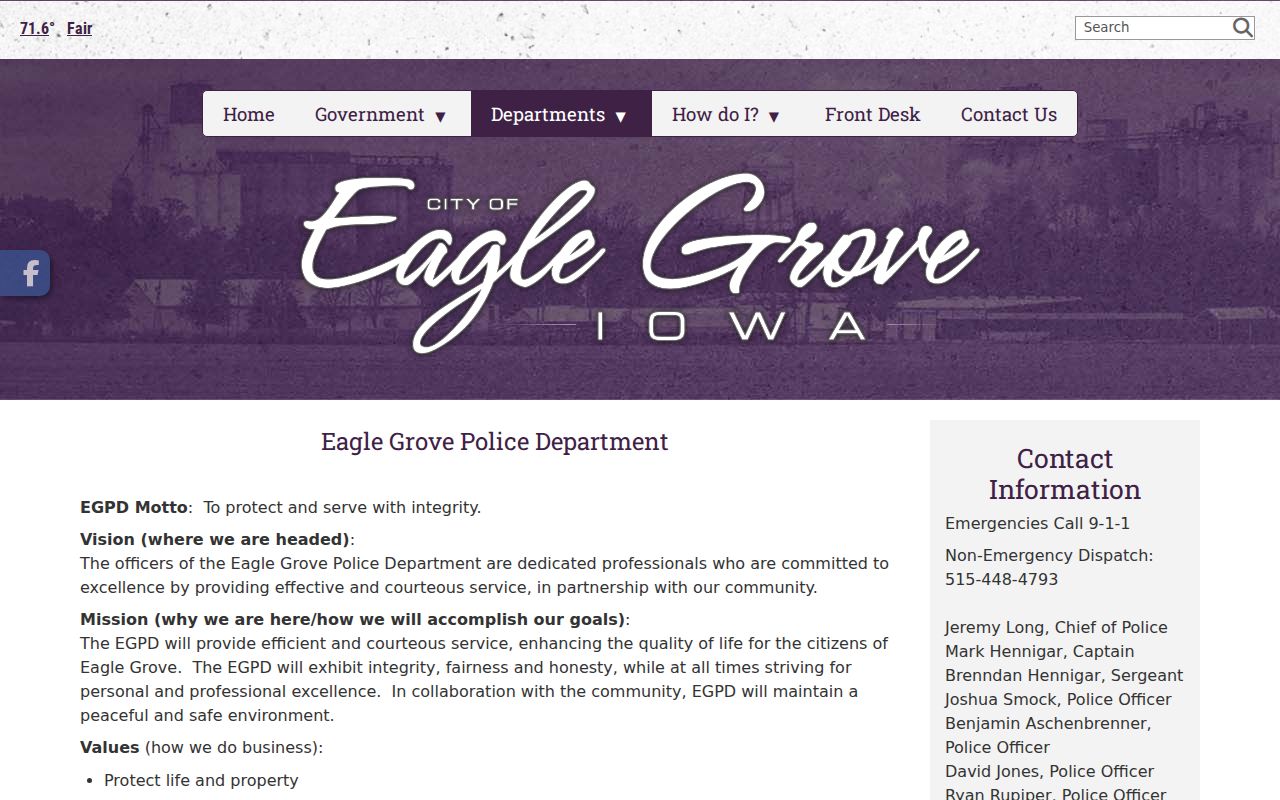
The police page is a contact channel, not a case search. Court outcomes and county jail status must be checked with their own custodians.
Eagle Grove Police Calls in Context
The joint Eagle Grove and Goldfield 2024 police report counted 3,734 Eagle Grove calls and 226 Goldfield calls. The combined 3,960 calls were down from 4,033 in 2023. Eagle Grove categories included 76 accidents, 23 assaults, 23 burglaries, 51 domestic calls, 13 drug violations, 30 OWIs, 49 search-warrant calls, 83 thefts, 899 traffic calls, and 67 welfare checks.
Those are service and incident categories, not conviction totals. Categories can overlap, and a call may end with no arrest or charge. For Eagle Grove criminal history, the annual report supplies local context, while a named person's legal outcome still requires the District Court docket. The report also describes eight full-time officers, three reserves, continuous Eagle Grove and Goldfield patrol, new body cameras, and a traffic-safety grant.
The Census place-estimate dataset ranks Eagle Grove first among Wright County's incorporated cities, at an estimated 3,583 people in 2024.

Population helps place call volume in context, but it should never be used as a shortcut for individual risk or guilt.
Arrests and Bookings in Eagle Grove
Eagle Grove officers create the arrest report and probable-cause narrative. Arrestees generally move to Wright County Jail in Clarion, where staff create the booking record, take identifying information, and record custody and release. The county publishes no online inmate roster. Its official inmate page directs current-custody questions to 515-602-6152.
Ask Eagle Grove Police for the city report and the jail for custody or booking facts. Then search the court docket for filed charges. These records can differ without one being wrong. Booking charges reflect what was presented at intake, while the Wright County Attorney decides which charges to file.
Note: An Eagle Grove arrest is not proof of guilt, and only the court file supplies the final disposition of a filed charge.
New Eagle Grove Booking, No Case
A fresh booking may appear before a case is indexed in Iowa Courts Online. Call the jail first for current custody. If police report access is needed, contact Eagle Grove Police with a narrow description. Recheck the state court portal after the charging decision, or ask the Wright County clerk whether a case has been filed but is not visible through anonymous online access.
A court search can also fail because the name is misspelled, the wrong county is selected, or an initial has a period. Iowa Courts Online requires at least two letters in the last-name field and accepts the percent sign as a wildcard. The delay between booking and a public case should not be filled with assumptions.
Eagle Grove Municipal Court Records
Eagle Grove does not operate a separate municipal criminal court or city criminal-case database. State citations, misdemeanors, and felony cases route into Iowa's unified District Court. Search Iowa Courts Online with Wright County selected, then contact the Wright County clerk on the courthouse's second floor when an older file, certified copy, or restricted online document needs review.
| Court Name | Iowa District Court for Wright County, Judicial District 2A |
|---|---|
| Case Types Heard | State felony, misdemeanor, magistrate, and related criminal proceedings |
| Case Lookup Channel | Iowa Courts Online basic search or the clerk's public-access terminal |
| What the Docket Shows | Case ID, parties, charges, events, disposition, judgment, sentence, and public financial entries |
| Copies & Fees | Ask the Wright County clerk about current plain or certified copy availability and cost |
A city police report is not part of the court file merely because both concern the same event. Request the Eagle Grove narrative from the police department, and use the clerk or statewide docket for the filed complaint, orders, disposition, and sentence.
Eagle Grove Case Search Uses Wright
Iowa Courts Online is organized by court county, not by an Eagle Grove municipal-court filter. In Trial Court Case Search, enter the indexed name or exact Case ID. Choose Wright County when narrowing local results. Use AND when both entered names must occur in one case, and OR when either may occur. Some advanced and schedule tools require a paid subscription or courthouse terminal.
A basic result can show public events and charge outcomes, but a missing document link does not prove that the filing is absent. Security levels, redaction, older paper records, and anonymous-user limits can all narrow what appears. The Wright County criminal court case record route gives the broader court-file context.
Where Eagle Grove Records End Up
Police reports remain with Eagle Grove Police. A fingerprintable arrest generally produces a jail fingerprint card that is sent to Iowa DCI. If the county attorney files a charge, the clerk creates the District Court record and later reports the disposition so DCI can match it to the arrest cycle.
Record flow: Eagle Grove Police Department › Wright County Jail and Iowa District Court › Iowa Department of Public Safety, Division of Criminal Investigation
Each stage answers a different question. The city report explains the officer's account. Booking records show custody. The court file shows litigation and outcome. DCI supplies the statewide fingerprint-backed history allowed by its release rules.
DCI states that its Iowa record begins with a fingerprint card. If no qualifying prints were taken and sent, that arrest will not create a repository entry. A blank DCI result therefore cannot replace a direct Eagle Grove report request or a Wright County case search.
Eagle Grove Criminal Records by Request
When no online report exists, Iowa Code chapter 22 gives a route to request an existing public record from Eagle Grove. Address the request to the city or police custodian and describe the event, date range, location, people or report number if known, and preferred delivery format. Ask for an estimate before authorizing a large search or copy job because no city police fee schedule was found in the reviewed sources.
The law does not require creation of a new summary. Police may redact protected identifiers and withhold confidential investigative material under section 22.7(5). Basic facts about an incident are generally public unless release would plainly harm an investigation or create a clear danger. A denial or partial release should identify the legal basis used.
Eagle Grove Report and Court Outcome
A police report records allegations and officer action at one point in time. The prosecutor can decline a charge, file a narrower charge, or change the legal theory. Later, a plea, trial, dismissal, acquittal, or deferred judgment may create a result that differs from the first report. Compare the report date and charge description with the docket's count-by-count disposition.
- Disposition
- The outcome of a charge, such as dismissal, conviction, acquittal, or deferred judgment.
- Docket
- The court's chronological list of filings, hearings, orders, and results.
- Deferred judgment
- An Iowa outcome that postpones judgment while conditions are completed; successful discharge is not a conviction.
- Expungement
- An outcome-specific process that makes qualifying records confidential under Iowa law.
One case can contain more than one charge and more than one result. Read every count separately, then use the final judgment or dismissal entry instead of treating the overall case status as the outcome of each allegation.
Eagle Grove Records and Rail History
Eagle Grove grew as a railroad center near the Boone River. City history ties the junction to natural springs used by steam engines and the name to a reported large eagle nest. The city incorporated in October 1881, and City Hall dates to 1914. Wright County itself organized in 1855 near the Boone River south of present-day Eagle Grove.
That history helps explain present record geography. Eagle Grove has its own police contact, yet the county seat and District Court clerk are in Clarion. A modern city incident can therefore leave records in Eagle Grove, at the county jail and courthouse, and at the state repository. Search by custodian, not by the assumption that all city records sit at City Hall.
Public Access Rules
Public access depends on record type. Eagle Grove Police applies chapter 22 to its reports. The Wright County clerk applies court security rules to filed cases. DCI uses chapter 692 to decide which criminal-history information can be released, including limits that change when no signed subject release accompanies a request.
Key Statutes:
Iowa Open Records Law opens public records unless a specific law makes them confidential and permits lawful actual costs.
Iowa Code chapter 692 controls criminal-history dissemination by DCI and the effect of a signed release.
Iowa Court Rule chapter 16 sets electronic court-file access and security levels.
Juvenile, expunged, sealed, victim, financial, and active investigative information may be confidential or redacted. Review a person's own record through official channels and bring a disputed entry to the office that created or maintains it.